Choosing an Auto Framing Camera for Meetings
A remote participant should not have to watch an empty chair every time the presenter steps toward a whiteboard. That is the practical value of an auto framing camera for meetings: it uses AI to recognize people in the room, then adjusts the shot to keep the active group visible without a person operating PTZ controls.
For small huddle rooms, hybrid classrooms, training spaces, and distributed production teams, the right camera reduces friction before and during a call. But auto framing is not a single feature with a single outcome. Camera placement, lens coverage, tracking behavior, room size, output format, and microphone design all determine whether the meeting looks controlled or constantly in motion.
What an Auto Framing Camera for Meetings Does
Auto framing identifies one or more people and calculates a useful composition. In a typical meeting, that can mean widening when additional attendees enter the shot, tightening when only one person remains, or centering a group around a table. The camera may use digital cropping, optical PTZ movement, or a combination of both.
This is different from simple face tracking. Face tracking usually prioritizes a selected individual. Auto framing is designed around the overall meeting composition, which makes it more appropriate for a conference room where speakers change often. Some AI cameras offer both modes, allowing an operator to choose group framing for a team call and presenter tracking for a training session.
The benefit is consistency, not novelty. A properly configured camera keeps remote viewers focused on the speaker, shared discussion, and visual material instead of distracting reframing. It also saves time for teams that do not have a dedicated AV operator in every room.
Start With the Room, Not the Camera Spec Sheet
The most expensive AI camera cannot compensate for a poor mounting position. Before comparing models, measure the distance from the planned camera location to the farthest seat, identify where people will stand, and consider whether a display, whiteboard, or lectern needs to appear in frame.
A narrow room with six seats may only need a compact 4K webcam with group framing. A larger boardroom may need an optical PTZ camera, especially if the camera is mounted at the far end of the room and must cover both a wide group shot and a closer presenter shot. Digital zoom can be effective for modest crops in 4K, but optical zoom preserves more image detail when the camera must frame subjects farther away.
Camera height matters as much as distance. Positioning a camera near eye level creates a more direct, professional view for remote participants. A camera mounted high above a display can work, but it tends to emphasize the tabletop and create less flattering angles. If high mounting is unavoidable, test the framing modes from actual seated and standing positions before final installation.
Windows are another common source of failure. AI framing may continue to work in difficult light, yet participants can still appear as silhouettes. Place the camera so bright windows are not directly behind speakers, or control the light with shades and room lighting. A camera with strong 4K imaging is useful, but lighting remains part of the system design.
Choose the Right Framing Behavior
Not every meeting benefits from the same automatic behavior. Group framing is generally the best default for recurring team meetings because it includes the people at the table and avoids unnecessary camera motion. In a classroom or product demonstration, presenter tracking can be more effective because the speaker may move across a defined area.
Look for cameras that let you adjust tracking sensitivity, framing speed, or tracking zones when those controls are available. Fast movement may keep pace with an energetic presenter, but it can also look restless during a calm discussion. Slower reframing feels more natural for executive meetings, provided the camera does not leave someone out of frame for too long.
A few practical questions reveal whether a mode suits the room:
- Does it keep seated participants visible when someone stands at the whiteboard?
- Does it avoid following people who walk behind the main meeting area?
- Can it return to a wide shot without abrupt, repeated zooming?
- Does it maintain a stable composition when multiple faces are detected?
4K Helps, but Output Compatibility Decides the Workflow
4K resolution gives an auto framing camera more image information for digital crops and gives the room a sharper, more credible appearance on large displays. It is particularly valuable when a camera must create a medium shot from a wider field of view. However, a 4K camera does not automatically mean every meeting platform receives a 4K feed.
Many conferencing applications, USB connections, and corporate network policies limit outgoing resolution. That does not make 4K unnecessary. A high-resolution sensor can still improve cropping flexibility and downscaled 1080p quality. It does mean buyers should verify the resolution and frame rate supported by the intended computer, video switcher, capture device, and conferencing platform.
Connection type should be selected around the workflow. USB is direct and practical for a single-room computer. HDMI is useful when routing the camera through a switcher, capture device, or AV distribution system. NDI is a strong option for networked production environments that need to move video across a local network without running dedicated video cables to every position.
For multi-room or multi-camera work, network management becomes part of the purchase decision. NDI cameras, PTZ control, and production computers need reliable wired network capacity. Wi-Fi may be convenient for a compact temporary setup, but fixed conference rooms and live events benefit from predictable wired connections.
PTZ, PTZR, and Webcam Designs Serve Different Rooms
A compact AI webcam is often the simplest answer for a one-person office, a huddle room, or a laptop-based meeting setup. It can sit near the display, connect over USB, and provide auto framing with minimal installation. This approach works best when the camera is close enough to the participants that large zoom ranges are unnecessary.
A PTZ camera adds motorized pan, tilt, and zoom control. It is the more flexible choice for larger rooms, lecture spaces, houses of worship, and corporate events where a camera may need to move between presets. Optical zoom and stored positions allow an operator to frame the room, a podium, or a demonstration area from one device.
PTZR cameras add a rotating body design that can support more flexible orientation and shooting angles. They are especially useful in compact production setups where creators or presenters may switch between horizontal and vertical content, or where camera positioning must adapt quickly. For meetings, the key question is whether that flexibility solves a real room-layout requirement rather than simply adding another feature to manage.
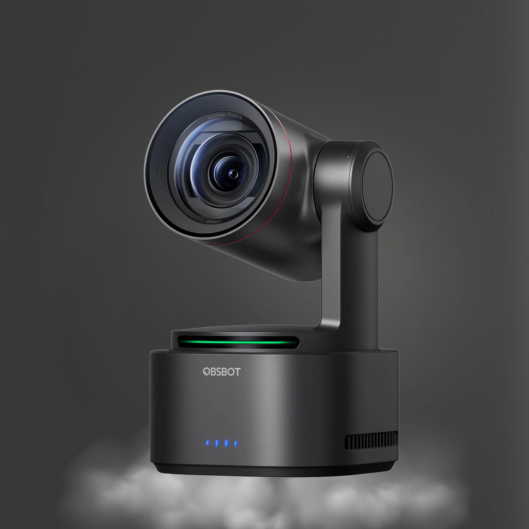
OBSBOT AI camera models are built around this distinction, from compact intelligent webcams to PTZ and PTZR options designed for more demanding tracking and production workflows. The correct category depends on coverage distance, control requirements, and whether the camera will remain a single USB source or become part of a broader video system.
Audio Still Carries the Meeting
Auto framing improves what remote attendees see. Clear audio determines whether they can participate. A camera microphone can be sufficient for a single presenter close to the device, but it is rarely the best choice for a group seated around a conference table.
For a small room, a dedicated USB conference microphone can provide broader pickup and better voice clarity than a camera-mounted mic. For a controlled presentation or training environment, a lavalier, headset, or wireless microphone keeps the presenter intelligible while moving. In production-oriented spaces, shotgun and supercardioid microphones can isolate a speaker more effectively, but their placement must be deliberate.
Avoid treating video and audio as unrelated purchases. A wide camera shot paired with distant, echo-heavy sound still feels unprofessional. Test the system with the actual seating plan, HVAC noise, room acoustics, and remote participants before relying on it for an important meeting.
Control, Presets, and Operator Override
Automation should reduce workload, not remove control when a meeting changes direction. The best setups retain manual PTZ control and stored presets even when AI framing is active. A preset for the full table, another for the whiteboard, and a third for the presenter can prevent the AI from making an unsuitable decision during a critical moment.
This matters most for executive briefings, live training, webinars, and hybrid events. In those environments, an operator may want automatic presenter tracking during a demonstration but a locked wide shot during audience questions. If the meeting is being recorded or streamed, route the camera through a switcher when you need to combine it with slides, a second camera, or media playback.
For buyers building a complete setup, Kong Kei Industrial can supply the connected pieces: AI cameras for framing, live video switchers for source management, and purpose-built microphones for intelligible speech. Selecting those components as a workflow prevents the common mismatch of a capable camera paired with limited audio or unsuitable video routing.
Make the Camera Disappear Into the Meeting
The goal is not for attendees to notice that the camera is intelligent. The goal is for remote participants to feel included without anyone stopping the conversation to adjust a shot. Start with the room geometry, choose framing behavior that matches the meeting format, and retain presets for the moments when automation should step aside.
A well-chosen auto framing camera becomes most valuable when it quietly handles routine coverage while your team concentrates on the work being discussed.