Best Camera for Solo Streaming for Serious Creators
A solo stream breaks down the moment your camera cannot keep up with the person running it. You may be presenting, demonstrating a product, teaching, gaming, or interviewing a guest while also watching chat and managing scenes. The best camera for solo streaming is not simply the one with the highest resolution. It is the one that holds a usable frame, delivers a clean signal, and fits the control workflow you can realistically operate alone.
For most one-person productions, AI tracking, reliable autofocus, flexible mounting, and straightforward connectivity matter more than a large camera body or a complicated lens collection. Once your stream includes movement, multiple platforms, or networked video, PTZ and NDI capabilities become major advantages rather than optional extras.
What Makes the Best Camera for Solo Streaming?
A solo operator needs automation that looks intentional. AI tracking is the first feature to evaluate because it replaces constant manual reframing. A camera should recognize the primary subject, maintain a stable composition, and respond naturally when the presenter moves across a set. Fast, erratic camera movement is distracting. Stable tracking with sensible framing is more valuable than tracking that reacts to every small gesture.
Resolution comes next, but 4K is useful for more than a sharper livestream. It gives you room to crop a wider camera image into a tighter shot for vertical clips, picture-in-picture layouts, or a second virtual angle. For a standard 1080p broadcast, a good 4K camera can preserve detail after cropping and improve the perceived quality of text, products, and demonstrations.
Then consider how the camera reaches your production system. USB is the fastest path to a laptop-based stream. HDMI works well when you use a capture device or live video switcher. NDI is designed for producers who want to move video across a local network, reducing the need for long HDMI runs and supporting flexible multi-camera layouts. The right connection depends on the rest of the workflow, not on a single specification.
Low-light performance also deserves a practical assessment. A camera cannot fully correct a poorly lit room. However, a larger sensor, effective noise reduction, and manual exposure control can help preserve natural skin tones and usable detail under modest lighting. Budget for a key light before assuming the camera alone will fix a dark scene.
Choose the Camera Class Before Choosing a Model
The correct camera category depends on whether you remain seated, move through a space, or operate a larger live production.
AI webcam for desktop streaming
An AI-powered 4K webcam is the most efficient choice for a streamer working at a desk. This setup is appropriate for live commentary, podcasts, online courses, business presentations, remote interviews, and gaming streams where the camera position stays close to the monitor.
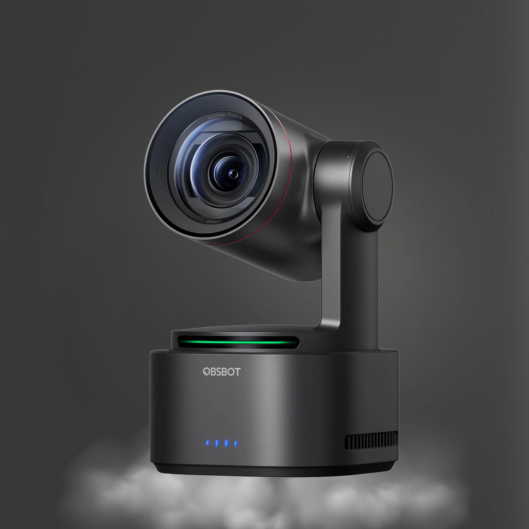
The OBSBOT Tiny 2 is a strong fit for this workflow. Its compact PTZ design and AI tracking help keep a single presenter centered without a camera operator. A dedicated webcam also reduces friction: connect it to the computer, set the framing, confirm exposure and white balance, then work in your streaming software. For solo creators, fewer adapters and fewer points of failure are meaningful production benefits.
Choose this class when your priority is speed, compact installation, and direct USB operation. The trade-off is physical reach. A desktop webcam is not the right tool for a wide studio, a stage, or a presenter who needs to move far from the computer.
Compact PTZ camera for active creators
A compact PTZ or PTZR camera is better suited to creators who demonstrate products, teach fitness or music, host standing presentations, or need a camera positioned across the room. Pan, tilt, and zoom provide framing control without moving a tripod, while AI subject tracking reduces the need for a second operator.
OBSBOT Tail Air is built around this more mobile workflow. It can serve as a flexible 4K camera for creators who need more placement freedom than a webcam allows. A camera positioned at a proper distance and height often produces a more polished result than a webcam placed directly above a monitor. It also keeps the desk clear for a keyboard, mixer, product samples, or notes.
For solo streaming, assess how you will control PTZ movement. Presets are especially useful. Set a wide presenter frame, a close product frame, and a secondary angle before going live. You can then change the visual rhythm of the broadcast without physically touching the camera.
Professional PTZ or PTZR camera for controlled productions
A higher-end PTZ or PTZR camera makes sense when the stream is a recurring business asset rather than an occasional broadcast. Corporate communications teams, houses of worship, event producers, and small studios often need longer zoom range, permanent installation, remote operation, and compatibility with broader production infrastructure.
This class is also the practical choice when you expect to add cameras later. A single camera may be enough for a weekly briefing, but product launches, panel discussions, worship services, and training events benefit from wide and close angles. Selecting cameras that can be centrally controlled protects the workflow as production requirements grow.
The trade-off is setup complexity. Professional cameras reward careful configuration of video format, network settings, control protocols, exposure, and color matching. They are not automatically better for someone who simply needs a clean face camera at a desk.
USB, HDMI, or NDI: Build Around Your Signal Path
USB remains the most direct option for a single-camera stream. It is well suited to OBS, video conferencing platforms, and compact creator rigs. Keep cable length realistic, use a reliable powered connection where needed, and test the camera at the intended output resolution and frame rate before a live session.
HDMI is often the best bridge to dedicated production hardware. It supports camera-to-switcher workflows and can be a sensible choice when you want physical buttons, multiple sources, or independent monitoring. A live video switcher can combine cameras, a computer presentation, and media playback while sending one finished feed to the streaming computer or encoder.
NDI is valuable when camera placement is the limiting factor. With a capable local network, an NDI-enabled camera can be located where it produces the best shot rather than where an HDMI cable happens to reach. It is particularly useful in classrooms, meeting rooms, studios, and venues where multiple cameras feed one production position. Network video requires planning: use dependable network hardware, confirm bandwidth, and avoid treating a crowded shared Wi-Fi connection as a production network.
Camera Features That Actually Reduce Solo Workload
A long feature list is not the same as a better live workflow. Prioritize features that remove repeat tasks during a broadcast.
AI tracking is useful when you move. Gesture control can be helpful when it is reliable and when it does not interrupt a presentation. PTZ presets provide repeatable framing. Manual exposure and white balance prevent visible brightness or color shifts after the stream begins. Remote control lets you adjust the camera from the operating position instead of walking back to the tripod.
Vertical and horizontal framing is increasingly relevant for creators producing live content and short-form clips from the same setup. A camera with flexible rotation or composition options can reduce the need to rebuild a studio for every platform. Still, determine the main destination first. A wide horizontal production can be cropped for vertical use, but important on-screen graphics and product details must remain inside the safe central area.
Do not overlook heat management and power. A camera used for frequent long broadcasts should have stable external power and a mounting position with adequate ventilation. A stream that looks excellent for 20 minutes but fails during a two-hour event is not professional equipment performance.
The Camera Is Only One Part of the Viewer Experience
Viewers will tolerate a good 1080p image more readily than poor speech intelligibility. Pair the camera with a microphone chosen for the room and speaking style. A CKMOVA lavalier can suit a presenter who moves around a set, while a shotgun microphone can work well when positioned close and aimed correctly. For a desk-based host, a dedicated vocal microphone may provide more consistent presence than a distant camera-mounted mic.
Lighting should be controlled before the stream. Use one soft key light at a flattering angle, then add fill or background separation only when needed. Lock the camera's white balance once the lights are set. This keeps the image consistent when a bright screen, window, or slide changes during the broadcast.
If you use multiple sources, a CineTreak live video switcher can reduce the pressure of managing everything inside software. A switcher gives you a direct path for moving between camera, presentation, and media inputs. It is not necessary for every solo stream, but it becomes useful when switching must be reliable and repeatable.
A Practical Buying Decision
Choose a 4K AI webcam if you stream from a desk and want the fastest, simplest route to professional framing. Move to a compact AI PTZ camera if you need room-scale movement, product demonstrations, or flexible camera placement. Select a professional PTZ or PTZR model when remote control, installation, long-range framing, multi-camera expansion, or NDI workflow is central to the production.
Before ordering, test the decision against the actual stream: where will you stand, how far will you move, what will viewers need to see, and who will control the camera while you speak? Kong Kei Industrial can help creators assemble the camera, switching, and audio components around those answers rather than around an isolated specification.
The best result is a setup that lets you focus on the message while the camera quietly maintains the shot. That is the real advantage of choosing production equipment designed for a one-person workflow.