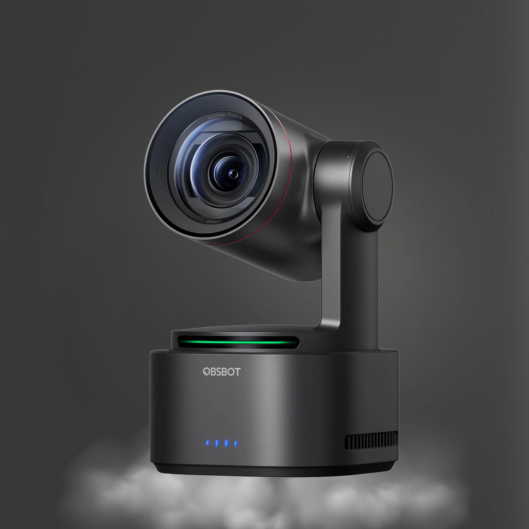
OBSBOT Cameras for Smarter Live Production
A static webcam forces the presenter to stay inside a narrow frame. A conventional PTZ camera often requires an operator to follow movement. OBSBOT cameras address both constraints with AI subject tracking, compact motorized movement, and 4K imaging designed for modern live production. For creators, educators, corporate teams, and small studios, that can mean a more polished production without adding another person behind the controls.
The right model depends less on a single headline specification than on the workflow around it. A solo presenter at a desk needs different hardware than a church streaming from a stage, or an event team feeding multiple network cameras into a switcher. Understanding where AI tracking, PTZ movement, NDI connectivity, and framing modes fit into the signal chain makes the purchase decision much clearer.
What OBSBOT Cameras Change in a Production Workflow
The central advantage is intelligent framing. OBSBOT AI tracking identifies a subject and adjusts the camera position to keep that person in view. This is especially useful when the speaker walks across a teaching area, demonstrates products at a standing desk, or moves during a livestream. Instead of manually reframing every few minutes, the operator can focus on switching sources, monitoring audio, or managing the program feed.
That automation is useful, but it is not a replacement for production planning. Tracking works best when the subject is clearly visible, lighting is consistent, and the movement area is defined. A busy stage with several people crossing paths may require lock-on controls, presets, or an operator who can take over at key moments. AI reduces routine camera work. It does not eliminate the need to decide what the audience should see.
Image quality also matters beyond the 4K label. Higher-resolution capture provides detail for close presentation shots and more flexibility when a platform, recorder, or switcher needs a clean source. In practice, lighting, lens placement, exposure, and a stable connection still determine whether the final stream looks professional. A well-positioned 1080p feed can outperform a poorly lit 4K feed.
Choosing OBSBOT Cameras by Use Case
Desktop streaming, remote meetings, and individual presentations
The OBSBOT Tiny series is built for close-range webcam workflows where a single speaker needs to remain framed while sitting, standing, or moving around a small workspace. Its compact form factor makes it practical for monitors, tripods, and portable setups, while AI tracking gives remote meetings and one-person broadcasts a more active camera presence than a fixed webcam.
A 4K Tiny model is a strong fit when facial detail, product demonstrations, and presentation video need to hold up on large displays or recorded content. Gesture and voice control features, where available, can also be valuable when the presenter is working alone and does not want to reach for a mouse or control app mid-session.
The trade-off is coverage. A desktop AI camera is designed around a nearby subject, not a large room or wide stage. For panel discussions, worship services, or events where the camera must cover long distances and multiple zones, a larger PTZ or PTZR camera is the better production tool.
Live events, education, worship, and studio sets
The OBSBOT Tail family is intended for more demanding camera positions. PTZR operation adds pan, tilt, zoom, and rotation capability, allowing the camera to follow a subject while adapting to horizontal and vertical output requirements. That is useful for teams producing a standard widescreen program feed while also creating vertical clips or live content for mobile-first channels.
Tail 2 is suited to productions that need more reach, more controlled movement, and a stronger live-event camera role. Its AI tracking can reduce the workload for a small crew, while presets and manual control give operators repeatable framing for a lectern, performance area, interview position, or demonstration table. For a multi-camera environment, the camera should be treated as one source in a planned system rather than as a stand-alone solution.
The compact OBSBOT Tail Air is particularly relevant when portability and network-based production are priorities. It can support flexible camera placement without the size and mounting demands of traditional broadcast PTZ hardware. The NDI version is a practical consideration for teams that already use network video infrastructure and want to move video, control, and monitoring across a managed Ethernet network.
Fixed framing and simple 4K webcam coverage
Not every setup needs a moving camera. A fixed OBSBOT webcam can be the more efficient choice for a product close-up, an overhead angle, a second speaker, or a consistent meeting-room view. Fixed cameras generally cost less, require less setup, and eliminate movement noise or tracking decisions from the workflow.
This is a case where buying the most advanced camera is not automatically the right move. If the talent remains seated and the composition never changes, a fixed 4K camera paired with controlled lighting and a quality microphone may provide the best return. Put budget toward a PTZ or PTZR model when the framing problem is real, recurring, and expensive to solve manually.
Building an OBSBOT Multi-Camera System
A capable camera is only one part of the production chain. Start by defining how each source reaches the program output. USB is convenient for a direct computer connection and compact creator setups. HDMI works well with capture devices and hardware switchers. NDI is designed for networked workflows, where compatible cameras and production systems share video over Ethernet.
NDI can simplify cable runs and camera placement, but it requires a properly planned network. Gigabit Ethernet, suitable switches, disciplined bandwidth management, and reliable power are not optional details when multiple feeds are live. Wi-Fi may be useful for setup or lower-risk applications, but wired networking is the safer choice for critical productions.
For a small studio, one tracking camera can serve as the primary presenter angle while a fixed camera handles a wide shot or product view. A live switcher can then move between sources, add graphics, and send a program feed to the streaming computer or platform. This approach creates visual variety without requiring a large crew.
Audio should be designed with the same care as video. AI tracking can keep a speaker centered in frame, but it cannot correct distant, echoing, or poorly isolated sound. A lavalier microphone is often appropriate for a moving presenter, while a shotgun microphone can work well for a controlled camera position. Conference microphones serve a different need: capturing multiple voices around a table with intelligibility as the priority. Matching the pickup pattern to the room is more productive than relying on a camera microphone as the final audio source.
Control, Presets, and Tracking Discipline
The best AI camera workflow combines automation with deliberate control. Before going live, set a camera height that approximates eye level, establish a clear movement area, and test whether the background creates enough subject separation. Save presets for repeatable positions such as a wide stage shot, a lectern close-up, and an interview chair. Presets are also useful as a recovery option when tracking has followed an unintended subject or needs to be paused.
Framing rules remain relevant even when the camera moves itself. Leave appropriate headroom, avoid placing the subject directly against a bright window, and keep important visual information inside the safe area for both horizontal and vertical output. If a presenter uses slides, a whiteboard, or product samples, test those actions rather than assuming tracking will anticipate them.
For event teams, designate one person to verify camera behavior during rehearsal. Check control response, video format compatibility, exposure changes, network stability, and audio sync before the audience arrives. A short technical run-through is usually more valuable than adding features at the last minute.
What to Confirm Before Buying
Confirm the intended output and connection method first. A camera chosen for USB conferencing may not be the right source for an HDMI switcher, and an NDI workflow requires compatible network infrastructure. Next, consider distance: close-range webcam tracking, room coverage, and stage coverage are different lens and movement requirements.
Also account for mounting, power, control access, and the number of simultaneous destinations. A solo creator may only need a camera and computer. A corporate communications team may need multiple sources, a switcher, separate audio capture, recording, and remote control. Building around the actual production path prevents unnecessary accessories and avoids a camera becoming the bottleneck.
Kong Kei Industrial brings OBSBOT cameras together with live switchers and purpose-built CKMOVA microphones, making it easier to specify a complete system rather than assembling unrelated gear. Once the camera is matched to the room, connection type, and audio plan, AI tracking becomes more than a feature on a specification sheet - it becomes practical production capacity when the live feed needs to keep moving.