Best Compact Studio Cameras for 4K Production
A compact studio camera earns its place when it removes work from the production team without compromising the shot. The best compact studio cameras combine 4K imaging, intelligent framing, remote control, and flexible video outputs in hardware that fits on a desk, tripod, light stand, or discreet wall mount. For solo creators, educators, corporate AV teams, and small studios, that can mean fewer operators, cleaner sets, and faster live production.
The right choice is not always the camera with the highest headline specification. A fixed-position webcam may be ideal for a close talking-head setup, while a PTZ or PTZR camera is the better investment for presentations, interviews, worship services, or multi-person productions. Start with the shot you need to protect, then select the camera movement, connectivity, and control workflow that support it.
What Makes a Compact Studio Camera Production-Ready?
Compact cameras vary significantly in how they handle movement, low light, lens reach, and live outputs. A camera intended for professional studio work needs more than a small footprint and a 4K label.
First, look at framing control. PTZ cameras pan, tilt, and zoom remotely, making them well suited to rooms where the presenter, audience, or stage position changes. PTZR cameras add a rotatable camera body, which is especially useful when a production must create both horizontal and vertical content without rebuilding the entire setup. A compact AI camera can also track a person automatically, preserving a usable frame when there is no dedicated camera operator.
Second, confirm the connection method. USB is practical for direct webcam workflows and video conferencing. HDMI integrates easily with switchers, monitors, and capture equipment. NDI allows a camera to send video over a network, reducing long HDMI runs and improving the flexibility of multi-camera installations. For a studio that plans to expand, connectivity is often more important than a small difference in sensor resolution.
Finally, consider how the camera behaves during a real session. Does it hold focus reliably? Can you recall framing positions with presets? Will AI tracking follow a presenter without making distracting corrections? Is its control method compatible with your switcher, computer, or network? These operational details determine whether a camera saves time or creates another task for the crew.
Best Compact Studio Cameras by Production Need
OBSBOT Tail 2 for advanced PTZR production
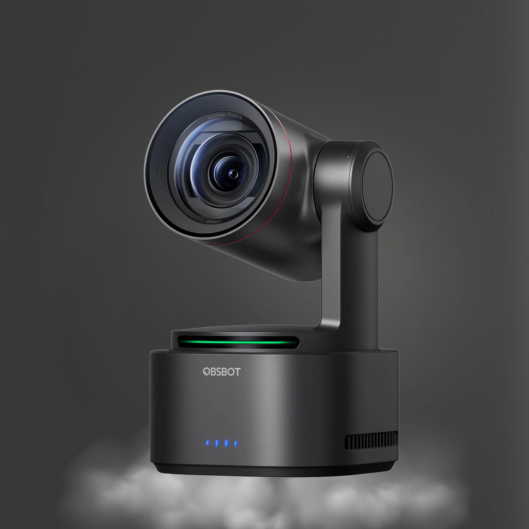
The OBSBOT Tail 2 is built for productions that need a compact camera with more creative reach than a standard webcam or entry-level PTZ unit. Its PTZR design combines pan, tilt, zoom, and a rotatable camera body, allowing operators to move between landscape and portrait-oriented output without physically repositioning the camera.
That is a practical advantage for studios producing a widescreen livestream alongside vertical clips for social channels. Instead of mounting two cameras or accepting a cropped image, the production can use camera rotation as part of its workflow. The Tail 2 also pairs AI tracking with a larger imaging system and optical zoom capability, making it a stronger fit for stages, product demonstrations, fitness instruction, interviews, and presenter-led programming where the camera may be positioned farther from the subject.
Its trade-off is simple: this is a more capable production camera, so it makes the most sense when the workflow will actually use its movement, tracking, and framing flexibility. A stationary desk setup does not need this level of camera control. A small studio producing multiple formats often does.
OBSBOT Tail Air for flexible multi-camera streaming
The OBSBOT Tail Air is a compact 4K AI-powered PTZ camera designed around adaptable live production. It is a strong option for creators and AV teams that need a camera they can place in positions where a full-size camera and operator would be impractical.
AI auto tracking helps keep a speaker, instructor, or performer framed as they move. PTZ movement adds the ability to establish a wide shot, move to a closer composition, and store useful camera positions for repeatable sessions. For multi-camera work, this helps a small crew create visual variety without assigning an operator to every angle.
Tail Air is especially effective for classrooms, meeting spaces, podcast studios, houses of worship, small event rooms, and livestream sets where compact placement matters. In NDI-enabled workflows, network video capability can simplify camera deployment and centralize video routing. That is valuable when cameras are mounted across a room or installed in locations where running dedicated video cable is inconvenient.
The key consideration is network planning. NDI workflows are efficient, but they depend on a stable network with sufficient bandwidth and well-managed infrastructure. For a single-camera desktop studio, HDMI or USB may be the more direct choice. For several cameras in a shared production environment, network video can be the cleaner long-term design.
OBSBOT Tiny 2 for premium desktop and close-range shots
The OBSBOT Tiny 2 is a 4K AI-powered PTZ webcam that makes sense when the camera will live close to the subject. It brings auto tracking, autofocus, gesture control, and motorized framing to desktop streaming, remote presentations, online training, and podcast camera positions.
For a creator working alone, its value is not simply that it follows movement. It can maintain a more intentional composition while the host demonstrates products, moves between a seated and standing position, or uses a whiteboard. A conventional webcam remains fixed unless someone manually adjusts it. Tiny 2 provides active framing in a form factor that does not dominate the desk or set.
This camera is best used at close to moderate distances. If you need tight shots from the back of an auditorium or wide coverage of a stage, a camera with optical zoom is the more appropriate tool. Tiny 2 is designed to make a personal studio, presentation desk, or compact interview area look more controlled with minimal setup.
OBSBOT Tiny 2 Lite for efficient 4K creator setups
The OBSBOT Tiny 2 Lite is a practical choice for creators who want 4K video and AI-assisted PTZ framing in a more accessible compact camera configuration. It is suited to streaming, video calls, online lessons, and simple studio productions that need a clear step up from a fixed webcam.
The strongest use case is a workflow where speed matters. Mount the camera, connect it to a computer, define the framing, and use intelligent tracking to stay centered while presenting. For solo channels, remote teams, and educators managing their own production, that reduced setup burden has real value.
Choose this type of camera when direct-to-computer operation is the priority. If the production includes switchers, long cable runs, several operator-controlled angles, or network video routing, a PTZ camera with broader production I/O will offer more room to grow.
Compact Studio Camera Comparison
| Camera | Best use | Key production advantage | Consider before buying |
| --- | --- | --- | --- |
| OBSBOT Tail 2 | Advanced creator studios, events, vertical and horizontal content | PTZR movement, AI tracking, flexible framing | Best when you will use its higher-end movement and lens capability |
| OBSBOT Tail Air | Multi-camera livestreams, classrooms, small venues | Compact 4K PTZ design with AI tracking and network-oriented workflows | Network setup matters for NDI-based production |
| OBSBOT Tiny 2 | Desktop studios, presenters, podcasts, online training | 4K AI tracking and motorized framing in a webcam format | Not intended for long-distance stage coverage |
| OBSBOT Tiny 2 Lite | Streamers, educators, remote professionals | Efficient 4K intelligent webcam workflow | Direct computer-focused workflows are its natural fit |
How to Build Around the Best Compact Studio Cameras
A camera does not work in isolation. A compact studio becomes more reliable when the camera, switching, and audio systems are selected as one workflow.
For a single-host stream, a 4K AI webcam, a purpose-built USB microphone, and controlled lighting may be all that is required. The camera keeps the host framed, while the microphone provides clear voice pickup without relying on the computer's built-in audio. This is the most direct path to a professional-looking desktop setup.
For a two- or three-camera studio, add a live video switcher. One compact AI camera can cover the host, another can hold a product or overhead angle, and a PTZ camera can handle wide shots or guest framing. Camera presets make repeatable shot changes faster, while a switcher gives the operator a central point for transitions, picture management, and multi-format livestream output.
For corporate and education environments, audio should be planned with the same care as camera placement. A high-resolution camera cannot compensate for speech that is distant, echoing, or interrupted by room noise. Conference microphones, lavalier systems, shotgun microphones, and vocal microphones each solve different pickup challenges. Select the microphone based on how many people are speaking, how far they are from the mic, and whether the room is treated for sound.
Choose for the Shot, Not the Spec Sheet
The best compact camera is the one that consistently delivers the framing your production needs with the least operational friction. If you work from a desk, prioritize 4K image quality, autofocus, and AI framing. If your subject moves through a room, prioritize PTZ control and reliable tracking. If your production needs multiple angles across a venue, plan for presets, switcher compatibility, and NDI or HDMI routing before you buy.
Kong Kei Industrial’s OBSBOT-focused camera range can support that progression from a compact desktop studio to a controlled multi-camera setup, with switching and audio equipment available for the rest of the signal chain. Build around the next production you expect to run, not only the one you are running this week.