How to Record Presentations With PTZ Cameras
A presenter who steps away from the lectern should not disappear from the recording. To record presentations with PTZ cameras effectively, the camera must follow real presentation behavior: walking to a screen, addressing an audience, demonstrating an object, and taking questions. That requires more than placing a camera at the back of the room. It requires deliberate framing, reliable control, and an audio path designed for speech.
PTZ cameras combine pan, tilt, and zoom movement in one compact unit. For corporate training, classrooms, houses of worship, product demonstrations, and conference sessions, they can replace the static wide shot that leaves the speaker too small to be useful. A properly configured PTZ workflow gives one operator, or in some cases no dedicated operator, the ability to maintain a professional shot while recording the complete session.
Why PTZ Cameras Fit Presentation Recording
A fixed camera records whatever happens inside its frame. That can work for a seated webinar host, but presentations are rarely static. Speakers turn toward slides, move across a stage, use a whiteboard, or invite another person onstage. A PTZ camera can move between saved positions or use AI tracking to hold the presenter in frame.
The operational advantage is just as significant as the visual one. A single PTZ camera can cover a wide establishing view, a medium shot of the speaker, and a close framing for demonstrations. In a multi-camera setup, it becomes a controllable source that can be switched alongside a slide computer, audience camera, or document camera. This reduces the physical camera footprint and the staffing required to create a watchable recording.
There are trade-offs. PTZ movement is not invisible, especially when the camera must travel a long distance between positions. AI tracking can also make the wrong decision if several people cross the stage or if the presenter moves behind a podium. The goal is not to automate every camera decision. It is to automate repeatable decisions and retain manual control for the moments that need it.
Position the Camera for the Room, Not the Stage
The most common presentation-recording problem begins with camera placement. A PTZ camera mounted too low creates an upward angle that is unflattering and makes slide screens dominate the image. A camera placed too far to one side forces a profile view whenever the speaker addresses the audience.
Mount the primary PTZ camera near the audience centerline, ideally at or slightly above the presenter’s eye level. The exact distance depends on the lens range, room depth, and whether the camera must also capture a screen or whiteboard. A long-zoom camera can be positioned farther back, but excessive distance may reduce detail in lower-light rooms and makes it more likely that people will walk through the shot.
Choose framing before enabling tracking
Start with a medium shot that includes the presenter from approximately the waist or chest upward. This is often the most useful framing for training, keynote, and internal communications recordings because viewers can see facial expression and hand gestures without losing context.
For a wide stage, set a second composition that shows the full presentation area. If slides are critical, use a separate direct computer capture whenever possible. Recording a projected screen through a camera introduces glare, keystone distortion, and exposure compromises. The PTZ camera should prioritize the human subject, while the switcher or recording software handles slides as a clean second source.
Avoid zooming so tightly that tracking has no margin. A presenter who leans, gestures broadly, or takes two steps sideways can be cut off before the camera corrects. A slightly wider frame is usually more professional than a close shot that repeatedly loses hands or headroom.
Use Presets for Repeatable Presentation Moments
Presets are the foundation of practical PTZ operation. Rather than manually steering the camera for every change, save exact positions for the places and activities that recur during the session. This is more predictable than relying on a single continuous tracking mode.
A standard presentation setup may include a centered speaker shot, a wide stage shot, a lectern position, a whiteboard or demonstration table position, and an audience Q&A shot. In a panel discussion, individual speaker presets can be useful, but only when seating positions remain fixed. If panelists shift often, wider group framing is less distracting than frequent camera moves.
Test presets with real people in the room. A framing that looks correct when the room is empty may place a standing presenter too close to the top of the image. Check the return speed as well. Fast preset movement is efficient during a live switch, while a recorded single-camera session may need slower transitions to prevent abrupt visual jumps.
Decide When AI Tracking Should Take Control
AI tracking is especially useful when one presenter moves through a defined area and no operator is available. Modern AI PTZ cameras can recognize a person, maintain composition, and adapt as the subject changes position. For solo instructors, fitness demonstrations, product presenters, and active lecturers, this can remove a major operational burden.
Tracking works best when the presentation area is visually clear and the primary subject is distinct from the background. Give the camera a defined tracking zone when that option is available. This prevents it from following someone walking at the edge of the room or reacting to activity in the audience.
For a keynote with frequent guests, awards, or demonstrations, use a hybrid approach. Keep AI tracking available for the main presenter, but use presets and manual PTZ control when another person takes the stage. An operator can also lock the shot during a critical demonstration so the camera does not reframe at the wrong moment.
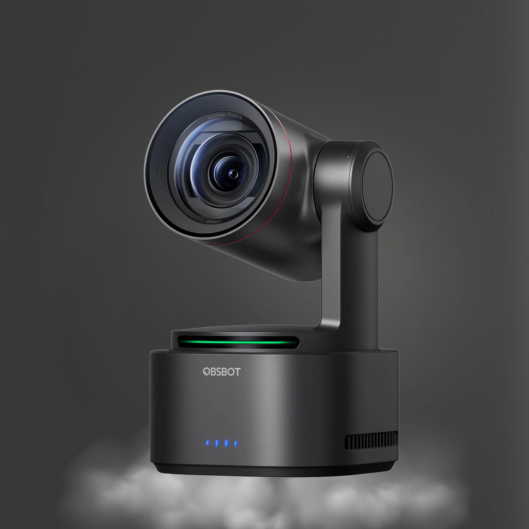
Kong Kei’s OBSBOT AI-powered PTZ camera range is relevant to this type of workflow because intelligent subject tracking can reduce manual camera operation while preserving the ability to use professional PTZ control when the scene becomes more complex.
Build Audio as a Separate Production System
Sharp 4K video does not rescue weak presentation audio. Room microphones often capture HVAC noise, audience movement, and reflections before they capture a presenter’s voice. For most speakers, a lavalier microphone or headset microphone provides the most consistent level as they move. A handheld microphone can work for formal podium sessions and audience Q&A, while a shotgun microphone is better suited to controlled, close-range pickup than a large reverberant room.
Route microphones through a mixer, audio interface, or video switcher with proper gain control. Monitor on headphones during the rehearsal, not only through room speakers. A PA system can sound acceptable in the venue while the recording receives a noisy or distorted feed.
If the presentation includes video playback, bring that computer audio into the recording system directly. Do not rely on a microphone to capture loudspeakers. Direct audio maintains clarity and avoids the delay or echo that can occur when computer playback enters the room and is captured again by open microphones.
Select the Right Recording and Control Path
A simple setup can record directly to a computer over USB. This is practical for a single camera, a remote presentation, or a compact training room. For longer sessions, confirm that the computer has sufficient storage, power management is disabled, and the recording application will not be interrupted by notifications or updates.
HDMI is a strong choice when connecting the PTZ camera to a hardware switcher, capture device, or dedicated recorder. It provides a direct video path with low operational complexity. SDI may be preferable for longer cable runs in event spaces and installed systems. NDI is useful when the venue already has reliable network infrastructure and the production team needs camera video, control, and potentially audio across Ethernet.
Networked production is not automatically simpler. NDI workflows depend on switch capacity, network design, bandwidth management, and reliable addressing. For a one-camera meeting room, USB or HDMI may be more practical. For multiple PTZ cameras in a large facility, NDI can reduce cabling and centralize control, provided the network is designed for video production rather than ordinary office traffic.
Record Presentations With PTZ Using a Two-Source Layout
The most useful presentation recording often contains two sources: the speaker camera and the slide feed. A live video switcher, software production platform, or presentation capture system can place these side by side, switch between them, or show slides full screen while retaining a small presenter window.
Before the event, decide which moments justify each layout. Use the speaker as the main image for introductions, stories, Q&A, and demonstrations. Give slides priority when they contain charts, software steps, or technical detail that viewers must read. A picture-in-picture layout is effective when body language matters but the slide remains the primary reference.
Record a clean master at the highest practical resolution and frame rate for the intended delivery. 4K provides useful flexibility for post-production crops, but it increases storage requirements and processing load. If the finished program will be distributed as 1080p and the session must run for hours, a well-lit 1080p recording may be the more efficient choice.
Rehearse the Failure Points
Do not reserve the first camera test for the audience arrival time. Walk the presenter through their normal movements, trigger every preset, test tracking near the edge of the stage, and confirm that the slide source is readable in the recording. Check for LED-wall flicker, projector exposure shifts, autofocus hunting, and camera movement that appears during a live shot.
Also create a fallback. Keep a wide preset ready if tracking fails, and record the slide computer separately when possible. If the primary PTZ control connection drops, the wide shot can preserve the session while the operator restores control. These small safeguards matter more than adding unnecessary complexity.
The best PTZ presentation recording feels controlled without calling attention to the technology. When the speaker remains well framed, the slides are legible, and every word is clear, the equipment has done its job: it keeps viewers focused on the presentation rather than the production behind it.